
Turn Your Chase Card Instacart Credits Into Food Bank Donations (Here’s How)

Look, we all do it. You get a credit card with some monthly benefit, feel really good about maximizing value for approximately 37 seconds, then completely forget it exists until you’re rage-scrolling through your credit card app six months later, wondering why you’re even paying the annual fee.
If you’ve got a Chase credit card with Instacart credits sitting there unused (and let’s be honest, you probably do), here’s your permission slip to feel good about yourself: you can funnel those benefits directly to food banks. We’re talking groceries delivered to Feeding America member food banks across the country, with you as the middleman, spending maybe two bucks out of pocket.
It’s the points game version of having your cake and eating it, too. Actually, it’s more like donating someone else’s cake and still getting the dopamine hit.
Which Chase Cards Come With Instacart Credits?
Before we get into the mechanics, let’s talk about who’s sitting on this goldmine. Chase rolled out Instacart benefits across a massive swath of their co-branded and business card lineup, valid through December 31, 2027.
Credit cards with $10 monthly Instacart credits:
Cards with $20 monthly Instacart credits:
All of these also include a complimentary three-month Instacart+ membership (activated by December 31, 2027). Which is great for groceries, sure, but most cardholders end up leaving these credits on the table every month because $10 doesn’t exactly cover a normal grocery haul, and remembering to use it feels like a part-time job.
Enter the better way.
Tip: Instacart+ membership stacks with every eligible card you connect, so the end date of you’re free membership will extend with each card you add.
What are Instacart Community Carts?
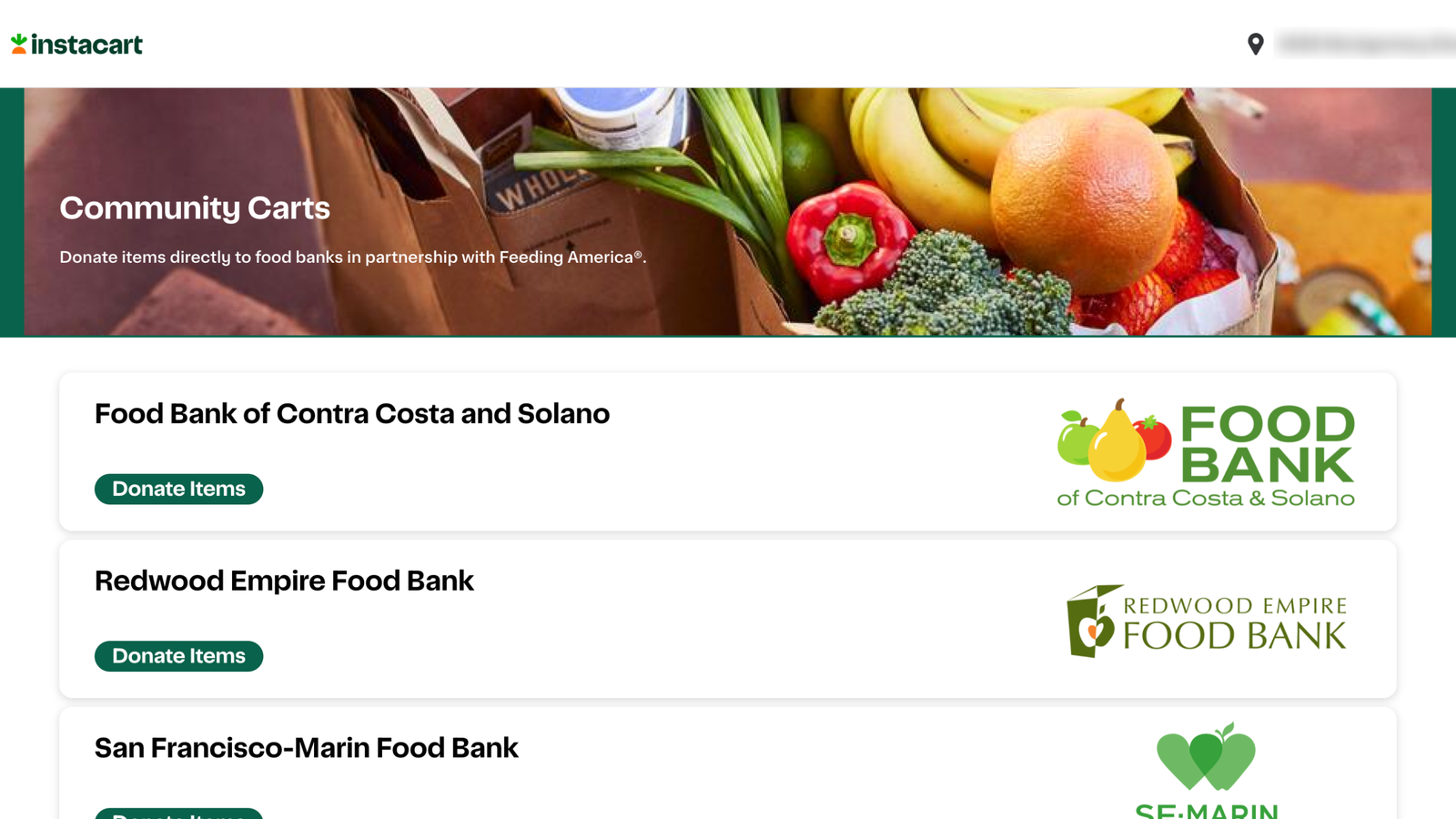
Instacart Community Carts is basically a food drive that doesn’t require you to leave your couch. It’s a partnership between Instacart and Feeding America that connects you with over 100 food banks nationwide.
Here’s what makes it actually usable: each participating food bank has a wishlist of its most-needed items. We’re not talking about you guessing what’s needed (spoiler: it’s probably not that artisanal jam you thought would be nice). These are curated lists of high-demand staples like canned goods, peanut butter, cooking oils, whole grains, and paper products. Many items cost between $1 and $3.
The best part? Instacart waives all delivery and service fees for Community Carts orders. The $10 order minimum still applies, but that’s it. An Instacart shopper picks up your donation order (along with dozens of others) and delivers it straight to the food bank’s door within five days.
The Real Cost to Donate Monthly Credits
Let’s break down why this isn’t just feel-good nonsense—it’s legitimately smart optimization.
Say you’ve got a Chase Marriott Bonvoy Boundless card that gives you $10 in Instacart credits each month. You connect that card to your Instacart account, head to Community Carts, and build a $10 order from a food bank’s wishlist.
Your $10 credit covers the groceries. Instacart defaults to a $2 tip for these deliveries, which is fair, since someone’s handling yours and dozens of other donation orders in bulk.
Your total out-of-pocket cost: Maybe ~$2.
For those two dollars, you’ve:
Got multiple eligible Chase cards? Even better. Each card gets its own $10 or $20 monthly credit. You can register multiple cards with Instacart and place separate orders on each one. A household with a World of Hyatt card, a Southwest Priority card, and an Ink Business Unlimited could theoretically donate $40 in groceries every month for about $6 out of pocket.
That’s nearly $500 in annual donations for roughly $72 of actual spending. The ROI for doing something decent? Priceless.
How to Donate Instacart Credits (Step-by-Step)
Connect your eligible Chase credit card(s)
Head to the appropriate registration link based on your card type:
Connect Chase Co-branded cards to Instacart (Hyatt, Marriott, Southwest, IHG, etc.)
Connect Chase Ink Business cards to Instacart
Connect Chase United cards to Instacart
When enrolling business cards, Instacart might try to get you to create a business account. You can say no—the card and credits will still attach to your personal profile.
Find Community Carts
Open the Instacart app or visit Instacart Community Carts. You’ll see a list of participating Feeding America food banks across the country.
Pick your food bank
You don’t have to live near the organization you choose. Want to support a food bank in your hometown while you’re living across the country? Go for it. Each food bank has its own page with a “Donate Items” button.
Shop the wishlist
Browse the food bank’s most-needed items. Load up your cart with whatever combination gets you to at least $10 (the minimum for Community Carts orders).
Check out with your Chase card
Make sure your eligible Chase card is selected as the payment method. Your $10 or $20 credit should be applied automatically at checkout. You’ll see it subtracted from your order total.
Add a tip
Instacart suggests $2, which seems reasonable for someone doing bulk order shopping and delivery (your order and dozens of others). This is your only real expense if you’re using exactly $10 of credit on a $10 order.
Tip: If you’ve got multiple eligible cards, you can repeat this process for each card to make multiple donations per month. Just switch which card is set as the payment method for each order.
When Should I Redeem the Credits
Here’s the thing about these monthly Instacart credits: they don’t roll over. Use ’em or lose ’em. And if we’re being real, how many months have you let them expire because you didn’t need groceries delivered or couldn’t be bothered to figure out how to use $10?
Plus, you finally have an answer when someone asks if you’re “maximizing your credit card benefits.” Yes. Yes, you are. In the most technically correct and socially beneficial way possible.
Frequently Asked Questions
Can I donate to any food bank in the country, or does it have to be local?
You can donate to any participating Feeding America food bank through Instacart Community Carts, regardless of where you live. The platform lists over 100 organizations nationwide, so if you want to support a food bank in your hometown or help a community affected by recent disasters, the choice is yours. Just pick from the list and shop their wishlist.
Do I need an active Instacart+ membership to use my monthly Chase credits?
Yes. Your monthly Chase Instacart credits only work if you have an active Instacart+ membership. The good news: all eligible Chase cards include a complimentary three-month Instacart+ membership (which is stackable with other eligible cards) when you enroll by December 31, 2027. The credits won’t work without it.
Can I get a tax deduction for these donations?
Potentially, yes. After your delivery is completed, you’ll receive an Instacart receipt detailing the items donated. You can reach out to the food bank you donated to with a copy of that receipt as proof of purchase to request a tax receipt for your donation. Keep in mind this covers your actual out-of-pocket expense (the tip and any amount over your credit), not the full value of the groceries. Consult with a tax professional for specifics.
What happens if an item I ordered is out of stock?
Your Instacart shopper will select a replacement, just like they would for a regular grocery order. Since you’re shopping from a food bank’s wishlist of needed items, any reasonable substitution will be useful. The food banks have input into what works for their operations, so replacements are generally appropriate.
Can I stack multiple Chase card credits in a single order?
No. Each credit is tied to a specific eligible Chase card, and you can only use one card per order. However, you absolutely can register multiple eligible Chase cards with Instacart and place separate Community Carts orders with each card. So if you’ve got three eligible credit cards, that’s three separate $10+ donations you can make each month, each using a different card’s credit.
Editor’s note: Opinions shared in this article are solely the author’s and do not represent the views of any bank, credit card issuer, hotel, airline, or other organization. The content has not been evaluated, approved, or endorsed by any of the mentioned entities. These are recommendations, not financial advice. I may receive a commission if you click through any of the links in this article.


Jason Lehigh
Jason is the founder of Live Rewarded, a blog dedicated to making points, miles, and cash back simple for everyone. Growing up with a frugal mindset and a knack for figuring things out on his own, Jason learned how to turn everyday expenses into travel, savings, and experiences worth remembering.
Through Live Rewarded, he shares clear, practical strategies to help you get more from the money you already spend.